The Story Behind the JustClock Name
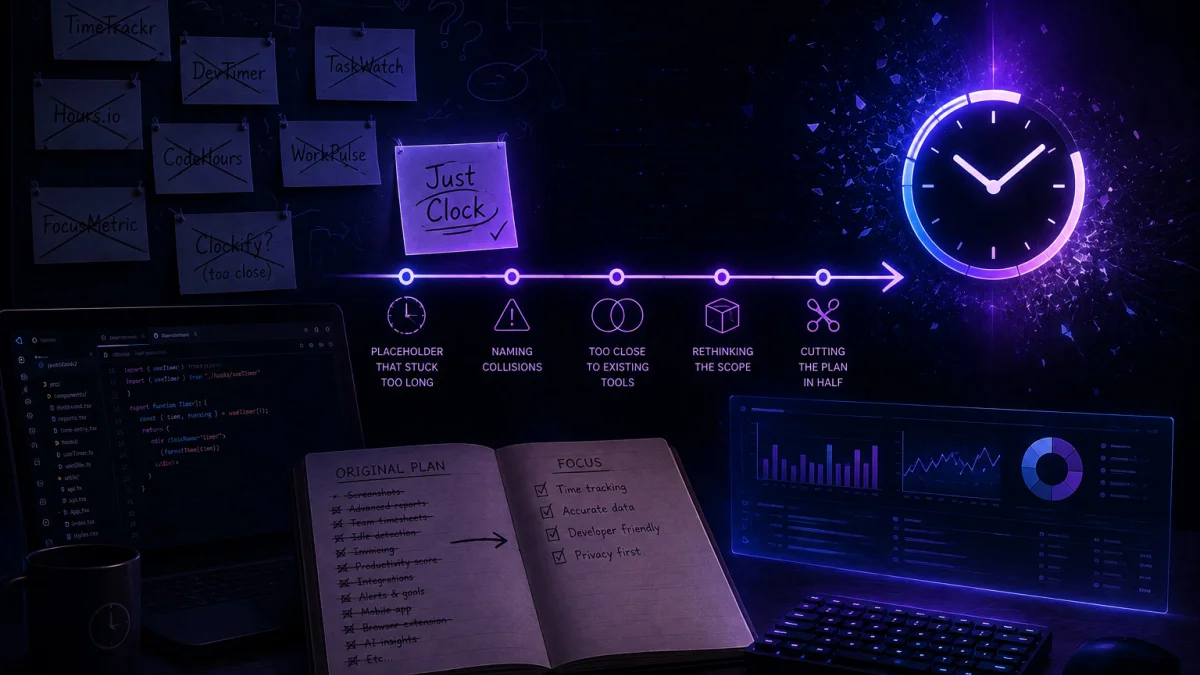
If you used this plugin before, you knew it as ProjectTimer. That name started as a placeholder. Early on, it needed something to call it internally, and the working title stuck around a lot longer than it was supposed to — right through a temporary subdomain, right through beta, and right through the point where actual users started relying on it day to day. That's usually how "temporary" names end up shipping: nobody wants to rename something people are already using.
We always knew that name was going to change eventually. It wasn't a last-minute decision — it had been the plan from early on. What kept pushing it back was that we wanted to run the beta through a real testing period first, including testing how installs and updates behaved when pulled directly through the JetBrains and VS Code marketplaces, rather than rushing a rename before we'd actually seen the plugin used in the wild. In hindsight, we probably could have made the move a little earlier. But once beta wrapped up, it was time.
Looking for a new name
Replacing ProjectTimer wasn't just about picking something new — the old name was also fairly generic, which made it easy to collide with. We went through three or four serious candidates before landing on the current one. More than once, a name we liked turned out to already belong to something else — sometimes in a completely unrelated field, which made it worse in a way, because there was no clean argument for "well, it's a different category, it's fine." It just wasn't fully ours.
What we were actually looking for was something short, easy to say out loud, and easy to remember after hearing it once. Beyond that, we wanted the name itself to say something true about what the plugin does — not describe a feature list, but capture the whole idea in one word.
Why "JustClock"
The plugin's entire philosophy is that you shouldn't have to think about it. It runs in the background, automatically switches context when you switch projects, and the only thing you ever actually do is glance at a report once in a while to see where your time went. No manual start, no manual stop, no daily interaction required.
"JustClock" is basically that philosophy compressed into two words — you just clock time, automatically, without managing the tool itself. Once that framing clicked, the other candidates stopped feeling right by comparison.
Why a .dev domain
This one was deliberate. .dev is a top-level domain aimed squarely at developers and developer tools, and it comes with a couple of properties that mattered to us: it enforces HTTPS by default, and the community association is exactly our audience. A plugin built for people writing code, hosted on a domain built for the same crowd, felt like the right fit — more than a generic .com would have signaled.
What actually changed for existing users
Short answer: almost nothing. If you had ProjectTimer installed, it's the exact same plugin — it just updates to the new name and branding automatically. Accounts and historical data carried over without any action needed on anyone's part. Where marketplace listings required keeping the original identifiers for continuity — so existing installs wouldn't break or need reinstalling — we kept them. The name changed. The plugin, your data, and your account didn't.
The whole migration itself took a matter of days, not weeks. Part of that is because we were already in the middle of shipping updated plugin versions anyway, so folding the rename into that release cycle avoided a separate migration effort entirely.
The part we quietly dropped along the way
Here's the more honest part of this story. Early on, we planned something a lot more ambitious than what shipped: in-IDE dashboards, project switchers built into the interface, cost calculations per project and per billing period — basically a small billing system bolted onto a time tracker.
The more we looked into it, the clearer it became that billing setups vary wildly from one developer to the next — different rates, different currencies, different invoicing habits, different client expectations. Trying to model all of that inside the plugin would have made it heavier, slower, and a lot more expensive to run and maintain. So we cut it. What's left is deliberately narrow: automatic time tracking and clear reporting, nothing else. That's also why the plugin stays lightweight and doesn't add noticeable overhead to your IDE, and why the subscription cost is close to symbolic rather than priced like a billing platform.
Sometimes the more honest version of a product is the one with less in it, not more.